A lot has changed since David and I started Celebrating Sagan in December of 2006. And while we've both moved on to other projects and different things, I've never been happy with how we left website. I especially always felt that it could and should be more.
Thanks to the help of Joel the site has been slowly coasting through the years accumulating a few a posts and a few comments here and there. Getting by but not really making any progress.
I've decided that with the 75th anniversary of Sagan's birth looming on the horizon, now might be a great time to reach out to the Celebrating Sagan community and see if we can elevate the site into a place where we -- in addition to celebrating the life of Carl Sagan through our memories -- celebrate the good doctor through new creative works, interpretations of his writings, or updates on his ideas. More than just a slow cascade of post cards, I believe that this can become a living and breathing testament to one man's passion and enthusiasm for life.
I know that time and resources are scarce for most... myself included. That is why I created this short survey. Please take a moment to provide some feedback. Your ideas help inform how Celebrating Sagan grows in coming years.
Thank you.
Bryan.
5.27.2009
4.15.2009
Across the Universe

Thomas Mallon has an article in the most recent issue of The Atlantic about solar sailing and The Planetary Society. In the article he interviews Ann Druyan and Louis Friedman.
As friends of Carl Sagan you all are probably familiar with the concept solar sailing, but for those that don't know, here is an excerpt from Mallon:
You can read the whole article, for free, here.In March of 2008, I sat down in the carriage house with Friedman and two other members of his solar-sailing team: Harris “Bud” Schurmeier, the retired project manager on the old Voyager missions; and Viktor Kerzhanovich, whose long career in both Russia and America has earned him the U.S.S.R. State Prize and more than one NASA Group Achievement Award. If the Planetary Society tends to exhort its more than 50,000 members in sonorous terms, conversation in the carriage house was speculative and playful. Throughout the morning, the years fell away from the three old-timers eager to tell a visitor about how solar sailing works—and to spar a bit.
“Light has energy,” said Friedman. “That you can’t argue with.”
“More important,” said Kerzhanovich, “it has momentum.”
“Therefore it has a force,” added Friedman. “You’re using the energy of light, and the force derived thereof, to transfer momentum of light energy to your vehicle, in order to propel the spacecraft. Basically your spacecraft, your solar sail, looks like a sail, but it really is a mirror. And so it’s reflecting the light, and that reflection is where the momentum transfer occurs.” If the mirror were fixed to a wall, there would be no transfer. But in free space, with no gravity and no air pressure? You’re off to the cosmic races.
“It’s not the solar wind,” Friedman reminded me.
“Things got named wrong,” said Schurmeier. However pretty it sounds, “sailing” is really a metaphor. There is such a thing as solar wind, but as Friedman explained, “Solar wind is electrons and protons that come from the sun, and they have mass, but they go very much slower than light.”
It’s photons, not protons, that we’re talking about?
“Right,” said Friedman. “Photons have no mass, they’re all energy. You do get a force from the solar wind, but it’s about a thousand times less than the force you get from this reflection. You turn your mirror in different directions, you can point the force in any direction you want!”
You can also contribute to The Planetary Society by becoming a member.


4.05.2009
"Carl Sagan Lives On" livejournal community
As the title suggests, on LiveJournal, there's a community called "Carl Sagan Lives On", described as "an open community dedicated to the life, wisdom, and legacy of Carl Sagan." It's been running since 2003, with 94 posts in total; the number of posts has tapered off recently (only 6 posts in 2008), but maybe this post will encourage a few LiveJournal users to join up (after all, the news that Cosmos is on Hulu prompted the most recent post).
3.24.2009
Cosmos is now on Hulu
Well, the website which has become known for offering up full-length TV shows (and a few movies) for free, ad-supported viewing (with a selection including a good amount of genre shows from The Addams Family to Firefly, but very light on science shows, and no, this doesn't count) has added the complete run of Carl Sagan's TV series to the mix. I guess this needs no further explanation, but Hulu's description is nice, especially the final sentence:
Man, I can remember quite a few of the home video incarnations of the series, beginning back in the 1990s with occasionally seeing the humongous boxed set of the series on VHS (sometimes with a paperback of the book thrown in for good measure) in science museum gift shops and the like; being completely overjoyed to find a fraction of the show's run on 2-episodes-per-VHS tape at a Blockbuster; the DVD release in 2000 with gorgeous packaging, going for $100 or more; last year's iTunes release for $1.99 an episode; and now, finally, this. I wouldn't go quite so far as agreeing with John Scalzi's comment that "the Internet has just justified its existence" (and the hardcore fans have a copy already, although now they won't have to lend out their copy to friends), but it's definitely the next step.
And of course, the news kicks off another round of Sagan fans' reminiscing about the impact of Cosmos and Sagan (just as the iTunes release did a year ago), in blogs (I'm pointing to a blog search rather than try to pick out favorites) and comment threads like this one.
In 1980, the landmark series Cosmos premiered on public television. Since then, it is estimated that more than a billion people around the planet have seen it. Cosmos chronicles the evolution of the planet and efforts to find our place in the universe. Each of the 13 episodes focuses on a specific aspect of the nature of life, consciousness, the universe and time. Topics include the origin of life on Earth (and perhaps elsewhere), the nature of consciousness, and the birth and death of stars. When it first aired, the series catapulted creator and host Carl Sagan to the status of pop culture icon and opened countless minds to the power of science and the possibility of life on other worlds.The version of the series used seems to be the same as the 2000 DVD version; it's especially nice to have Ann Druyan's introduction at the beginning of the first episode, as well as the 1990 updates at the end of episodes like The Edge of Forever. (I'm guessing that the DVD music changes are still in there.) And unfortunately, the website is restricted to viewers in the United States.
Man, I can remember quite a few of the home video incarnations of the series, beginning back in the 1990s with occasionally seeing the humongous boxed set of the series on VHS (sometimes with a paperback of the book thrown in for good measure) in science museum gift shops and the like; being completely overjoyed to find a fraction of the show's run on 2-episodes-per-VHS tape at a Blockbuster; the DVD release in 2000 with gorgeous packaging, going for $100 or more; last year's iTunes release for $1.99 an episode; and now, finally, this. I wouldn't go quite so far as agreeing with John Scalzi's comment that "the Internet has just justified its existence" (and the hardcore fans have a copy already, although now they won't have to lend out their copy to friends), but it's definitely the next step.
And of course, the news kicks off another round of Sagan fans' reminiscing about the impact of Cosmos and Sagan (just as the iTunes release did a year ago), in blogs (I'm pointing to a blog search rather than try to pick out favorites) and comment threads like this one.
11.09.2008
Ann Druyan special on Equal Time for Freethought
Today, to mark Carl Sagan's birthday (he would have been 74), the WBAI radio program Equal Time for Freethought broadcast a special interview with Sagan's widow and collaborator Ann Druyan (the half-hour interview was originally intended for a fund drive show in September, but not aired in its entirety until now). An audio permalink will be added to equaltimeforfreethought.org soon, but for now, it can be found at the WBAI archive here and also temporarily in WMA format here.
The main news is NASA's establishment of a Sagan Fellowship to study exoplanets (planets outside the Solar System), but the conversation ranges from the profound (how to communicate the wonder of science) to the quirky (an extended discussion of what Sagan ate for breakfast). Check it out!
Cross-posted to my personal blog.
The main news is NASA's establishment of a Sagan Fellowship to study exoplanets (planets outside the Solar System), but the conversation ranges from the profound (how to communicate the wonder of science) to the quirky (an extended discussion of what Sagan ate for breakfast). Check it out!
Cross-posted to my personal blog.
11.03.2008
Carl Sagan jack-o'-lantern
By Caleb Pennypacker, via Nick Sagan's blog:
This brings back memories, since one of Nick's earliest posts ever on his blog referenced an illustration that I made for Halloween 2005 combining a pumpkin with a famous scene from Georges Méliès's Le Voyage Dans la Lune.
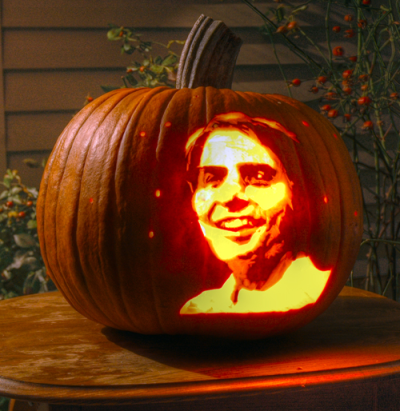
This brings back memories, since one of Nick's earliest posts ever on his blog referenced an illustration that I made for Halloween 2005 combining a pumpkin with a famous scene from Georges Méliès's Le Voyage Dans la Lune.
10.02.2008
Sagan and Reagan
Over at the ScienceBlog Framing Science, Matthew Nisbet wrote about two men that he considers to be the top communicators of the 1980s, President Reagan and Dr. Sagan:
In the years before cable television fragmented Americans into ever smaller viewership groups, both men took advantage of the broadcast television networks to communicate directly to a mass audience. Reagan would make speeches during prime time from the Oval Office such as his 1983 call to scientists to develop the Strategic Defense Initiative. "I call upon the scientific community in our country, those who gave us nuclear weapons, to turn their great talents now to the cause of mankind and world peace, to give us the means of rendering these nuclear weapons impotent and obsolete," declared Reagan.Follow through to the original post for video.
And before The Daily Show or The Colbert Report turned late night comedy into platforms for scientists such as Neil deGrasse Tyson, Sagan would appear as a regular on Johnny Carson reaching tens of millions of viewers. The astronomer was so familiar to American audiences that Carson would even affectionately impersonate Sagan in skits.
4.22.2008
Carl Sagan in Time Warner Presents The Earth Day Special (1990)
In one segment, Sagan appears in full Cosmos explainer mode, lecturing an attentive audience on the scientific basis for understanding global warming, ozone depletion, and acid rain. The script was written by Sagan and Ann Druyan themselves, and they also penned an appropriately Cosmos-like opening narration about Earth's place in the universe:
We have searched the skies for signals. Our spacecraft have explored dozens of exquisite worlds in the family of our sun. But as far as we've looked, there's only one place in the entire universe where the miracle of life exists: our own planet Earth. Life is so rare and precious. We must safeguard, protect, and cherish it.Sagan is also one of the scientific advisors listed in the credits.
(I've also posted a lengthier, but less Sagan-centric, take on the special on my personal blog.)
2.12.2008
Contact on TCM's 31 Days of Oscar

On Sunday, February 24th, Turner Classic Movies will be airing Contact as part of this month's "31 Days of Oscar", in which Academy Award-winning movies are showcased.
Check out the TCM Movie Database entry for the film. Sean Axmaker provides an excellent overview of the film, from the production history to the issues and themes involved; Sagan is described as "one of the most effective spokesmen for the advancement of science and space exploration in the world", and the entry also includes a quote from Ann Druyan:
"Carl's and my dream was to write something that would be a fictional representation of what contact would be like," explains Ann Druyan, Sagan's wife and collaborator. "But it would also have the tension inherent between religion and science, which was an area of philosophical and intellectual interest that riveted both of us."Each night's worth of movies is organized by a specific decade (all the way from the 1920s to the 1990s and 2000s); it so happens that immediately before Contact on the schedule is a somewhat different 1997 alien contact science fiction film, Men in Black. Saganites have mixed opinions on the merits of MIB; Keay Davidson in his biography of Sagan dismisses it as a dumbed-down "mean-spirited bloodbath"; whereas pop-culture-savvy Nick Sagan slipped in an homage (or more precisely, an homage to an homage) to it in his short story "Tees and Sympathy":
I thought that was clear. The reason why I’m wearing a black suit and sunglasses is because I’m homaging Men in Black.And Phil Plait answers the question of how "a skeptical, UFO-bashing, aliens-aren't-visiting-us-and-excoriating-cow- you-know-whats scientist-type guy" can enjoy the film in his review:
I loved this movie.Surprised? "What's a skeptical, UFO-bashing, aliens- aren't-visiting-us-and-excoriating-cow-you-know-whats scientist-type guy going around saying he loves a movie whose very premise is that not only do aliens exist, but live among us?" you are asking yourself.
Well, the movie is awesome. It rocks. I laughed all the way through it. It's funny. It's also satirical, poking gentle but firm fun at the whole UFO and alien subculture.
(Also, for all the differences in tone, note that both films use a shot consisting of an extended zoom out from Earth to outer space to comment on humanity's place in the universe.)
2.10.2008
"Shadows of Forgotten Ancestors" released on DVD last week
If you're wondering why you never heard of a spinoff of Cosmos based on Carl Sagan and Ann Druyan's book of the same name, it's because the film in question — a 1964 Soviet film by Sergei Parajanov — was instead the source for the name of the Sagan/Druyan book! (Also, the film is not a documentary as one might expect, but fiction.) This seems to be the first North American region DVD release. Some links to stuff about the film:
Subscribe to:
Posts (Atom)

 Posts
Posts


