9.18.2009
9.08.2009
8.20.2009
Sounds of Earth
Probably the most humanizing and often talked about aspects of Voyager is the Golden Record... humanity's message to the unknown. Here you can listen to just a few of NASA's original recordings that were featured on the record.
For more on the Golden Record, check out this post from 2006.


from the New York Times, August 20, 1977
CAPE CANAVERAL, Fla., Aug. 19--The Voyager spacecraft scheduled for launching tomorrow to scout Jupiter, Saturn, and possibly Uranus will be carrying a message from Earth on the off chance that extraterrestrial beings will come upon the craft centuries from now, somewhere on its endless journey beyond the solar system.
The message is in the form of a recoding, called "Sounds of Earth." It is a 12 inch copper phonograph record inserted in an aluminum protective jacket that is attached to the outside of the 1,820 pound spacecraft.
Dr. Carl Sagan, the Cornell University astronomer who conceived the idea, calls the recorded message a "bottle cast into the cosmic ocean."
Languages and Nature

Inscribed on the record are nearly two hours of greetings in dozens of human languages, samples of music of various cultures and times, natural sounds such as the wind and surf and animals and birds, and a message from President Carter.
All preparations were reported to be running smoothly for the launching at 10:25 A.M. tomorrow at the Kennedy Space Center here. The spacecraft, called Voyager 2 even though it is to be the first of the two craft to be launched in the Voyager program, is to
be blasted into its interplanetary course by a Titan 3E Centaur rocket.
George F. Page, the director of the mission launching operations at the space center, said today that "everything is proceeding right on time" and that the forecast was good launching weather.
Voyager2, equipped with television cameras and scientific instruments, is to fly by Jupiter in 1979, Saturn in 1981 and, if all continues to go well, Uranus in 1986. An identical spacecraft, Voyager 1, scheduled for launching Sept. 1, is to explore Jupiter and Saturn. The missions call for the most far-ranging reconnaissance of the outer solar system thus far.
'A Very Big Step'
At a news conference today, Dr. Edward C. Stone, the project scientist from the California Institute of Technology, described the Voyager missions as "a very big step in extending our ability to observe our surroundings and the solar system."
The $400 million project has been five years in preparation, directed for the National Aeronautics and Space Administration by the Jet Propulsion Laboratory of Pasadena, Calif. The idea of attaching a phonograph message to the space vehicle was an afterthought.
The messages on the record were designed to enable possible extraterrestrial civilizations that might intercept the spacecraft millions of years hence to put together some picture of 20th century Earth and its inhabitants. The record runs about two hours.
The record contains, in scientific language, information on how it is to be played, using the cartridge and needle provided. The first eight minutes consist of a wavy, electronic hum, which is the transmission of 115 photographs and diagrams in electronic form depicting the mathematics, chemistry, geology and biology of the Earth and a description of the solar system.
The President's Message
One of the messages, in electronic form, is a letter from President Carter. It reads, in part:
"We cast this message into the cosmos. It is likely to survive a billion years into our future, when our civilization is profoundly altered and the surface of the Earth may be vastly changed. Of the 200 billion stars in the Milky Way galaxy, some--perhaps many--may have inhabited planets and space-faring civilizations. If one such civilization intercepts Voyager and can understand these recorded contents, here is our message:
"This is a present from a small distant world, a token of our sounds, our science, our images, our music, our thoughts, and our feelings. We are attempting to survive our time so we may live into yours. We hope someday, having solved the problems we face, to join a community of galactic civilizations. This record represents our hope and our determination, and our good will in a vast and awesome universe."
The musical selections represent many cultures and many times, including Eastern and Western classical music, ethnic music, and jazz and rock-and-roll. There is Bach's Brandenburg Concerto No. 2, Beethoven's Fifth Symphony, "Johnny B. Goode" by Chuck Berry, A Navajo Night Chant, Peruvian Woman's Wedding Song and Australian Horn and Totem Song.
"Because space is very empty, there is essential no chance that Voyager will enter the planetary system of another star," Dr. Sagan said. "The spacecraft will be encountered and the record played only if there are advanced space-faring civilizations in interstellar space.
August 20, 1977
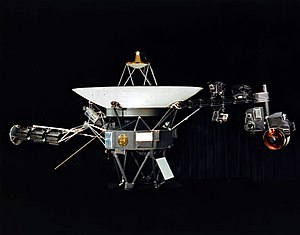
Voyager 2 launched 32 years ago today, and to celebrate, we're going to publish a few Voyager related posts.
Stay tuned.
8.11.2009
"Shadows of Forgotten Ancestors" screening in NYC
The 1964 film by Sergei Paradjanov which provided the title for Carl Sagan and Ann Druyan's book (and whose DVD release was noted here previously) is being screened, in a new 35mm print with subtitles, at Anthology Film Archives in NYC on the 21st and 23rd. AFA's website describes it as "[a] boldly conceived and astonishingly photographed blend of enchanting mythology, hypnotic religious iconography, and pagan magic."
7.15.2009
God, the Universe and Everything Else
"Feeling unhappy because it isn't immediately understandable."
"Nothing will put astrologers out of business."
Here is a video of Stephen Hawking, Carl Sagan, and Arthur C. Clarke talking about everything and everything's beginning. It consists of questions and answers. The first point that Carl Sagan makes in this video is about questions and answers. He goes on to talk about answers in his own answers. Many people in this world are obsessed with finding and having answers to the questions that they encounter in their lives. Carl Sagan was not one of these people.
The canon of human knowledge will always be finite. The remainder of available knowledge in the universe will always be infinite. Carl Sagan encouraged us to celebrate that which we do not know, and attack it with questions and investigation. With full understanding that the task of science is undoubtedly insurmountable, we attempt it anyway. Not only is the task of science insurmountable, it is constantly working against itself. As soon as we figure something out, that new knowledge has a pesky habit of creating even more questions. Those people who recognize this fact, and purse the pursuit anyway are those who wind up finding the greatest answers.
Sadly, so long as there are things which we do not understand, and indeed there always will be, there will be people who will seek a shortcut to answers without even knowing the right questions to ask. It's easier to follow the words of a charismatic leader, to believe in psychics, blame personal shortcomings on fate, or settle a dispute with violence than to seek and confront an uncomfortable truth.
On behalf of all those he helped make the jump into rejecting dogma and seeking truth through rational inquiry knowing we will never fully find it, let me say thank you to Carl Sagan.
-- submitted to Celebrating Sagan by Dave Lodewyck.
7.13.2009
new blog: According to Carl Sagan

There's a brand-new Sagan-related blog in town; topics in the 4 posts so far have ranged from the evolutionary origins of sports to neglected rocket pioneer Robert Goddard. Since Carl weighed in on a truly wide variety of topics, there should be plenty of material to blog about.
(Hat tip: Francois Tremblay; cross-posted to my personal blog)
6.24.2009
6.22.2009
Carl Sagan's Barsoomian blurb
I recently discovered that the back cover of the 2007 Penguin Classics edition of A Princess of Mars by Edgar Rice Burroughs has a prominent blurb by Carl Sagan: "Might it really be possible—in fact and not fancy—to venture with John Carter to the Kingdom of Helium on the planet Mars?" Although the cover does not specify the source of the quote, it's from the "Blues for a Red Planet" chapter from Cosmos; references to his being a fan of the John Carter books since first reading them as a kid appear scattered throughout Sagan's writings, including an anecdote about obtaining a related vanity plate (due to a limit of 6 letters per plate, he had to settle for "PHOBOS" instead of his first choice, "BARSOOM"). And this hasn't been the first time that Burroughsians have noticed Sagan; for instance, consider the Burroughs fansite ERBzine's lengthy tribute to Sagan.
I'd be happy to see more Sagan blurbs on other science fiction books; he had a generally favorable view of science fiction in general (with some caveats about scientific errors and the promotion of pseudoscience) and had nice things to say about quite a few science fiction classics in his writings, for instance in the essay "Science Fiction—A Personal View" in Broca's Brain, or the extended discussion in Pale Blue Dot (which I was quite surprised to see when first reading it) of a 1942 short story by Jack Williamson dealing with antimatter and asteroid colonization, "Collision Orbit" (which was incorporated into the fix-up novel Seetee Ship). (By the way, I've always wondered if the character Jane Carter in Williamson's The Humanoids was a Burroughs reference, with the character's teleportation abilities being a takeoff on Burroughs's use of astral projection to get John Carter to Mars.)
I'd be happy to see more Sagan blurbs on other science fiction books; he had a generally favorable view of science fiction in general (with some caveats about scientific errors and the promotion of pseudoscience) and had nice things to say about quite a few science fiction classics in his writings, for instance in the essay "Science Fiction—A Personal View" in Broca's Brain, or the extended discussion in Pale Blue Dot (which I was quite surprised to see when first reading it) of a 1942 short story by Jack Williamson dealing with antimatter and asteroid colonization, "Collision Orbit" (which was incorporated into the fix-up novel Seetee Ship). (By the way, I've always wondered if the character Jane Carter in Williamson's The Humanoids was a Burroughs reference, with the character's teleportation abilities being a takeoff on Burroughs's use of astral projection to get John Carter to Mars.)
Subscribe to:
Posts (Atom)

 Posts
Posts


